From Bad to Ugly: What a Record-Low Snowpack Means for the Poudre Watershed
Record-low snowpack. A mid-March heat wave. For the Cache la Poudre River Watershed, 2026 is shaping up to be a year unlike any before.
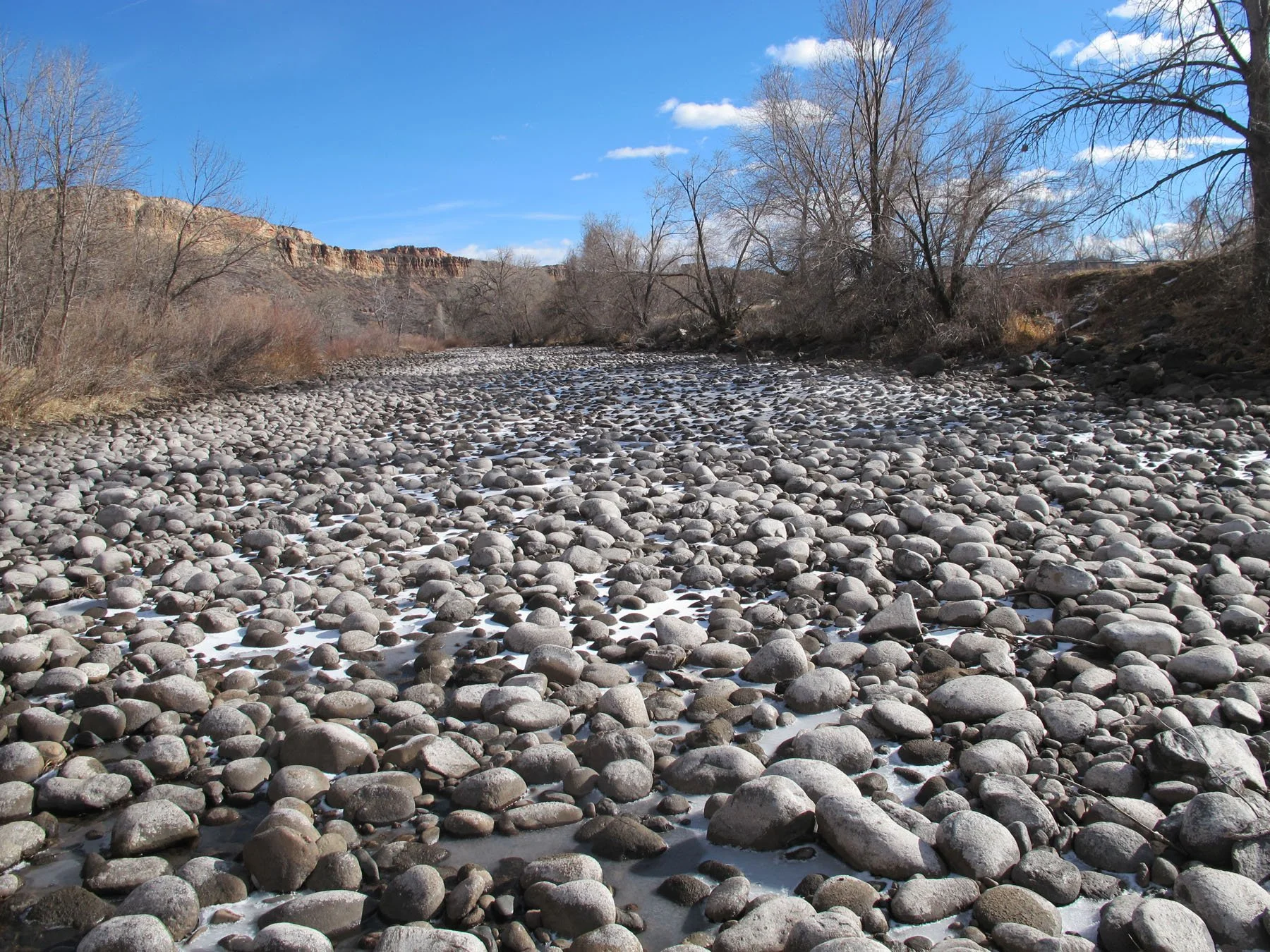
A dry up point on the Cache la Poudre River near Watson Lake (Photo credit: Colorado Water Trust).
Every spring, northern Colorado holds its breath and watches the mountain snowpack. This snow that accumulates through winter is more than a scenic backdrop, it is the region's water supply, releasing slowly through spring and summer to fill rivers, reservoirs, and aquifers. This year, there is precious little snow blanketing the peaks. And what remained after a historically dry winter was largely gone by mid-March, erased by a heat wave that arrived weeks ahead of schedule.
For the Cache la Poudre River Watershed, and for all of northern Colorado, the consequences of this winter will unfold through the months ahead. Understanding what happened, and what it means, is the first step toward responding wisely.
A Winter That Never Arrived
Warm, dry conditions dominated Colorado's mountains from October onward. When precipitation did fall, temperatures were often too high for it to come down as snow, and what snow did accumulate melted early. By January 1, statewide snow water equivalent sat at just 56 percent of the historical median, with roughly 38 percent of long-term monitoring sites recording their lowest readings on file. Colorado's state climatologist described the deficits as unusually large for early March, calling low streamflows a near certainty for the coming season.
Then, in the second week of March, temperatures surged across the state, shattering records in communities up and down the Front Range. Fort Collins had already experienced more than 40 days above 60°F this winter, which is more than double the previous record. The heat wave accelerated snowmelt so rapidly that Colorado's snowpack may have hit its seasonal peak around March 9, a full month before the typical early-April high point. By the time temperatures moderated, the statewide snow water equivalent had dropped to roughly half of what a normal peak year holds, and much of what melted simply evaporated in the heat rather than reaching streams and soils.
This combination - record-low snowpack struck by an unprecedented early heat wave - has no historical precedent in Colorado's climate record. Water managers, scientists, and forecasters are navigating genuinely uncharted territory.
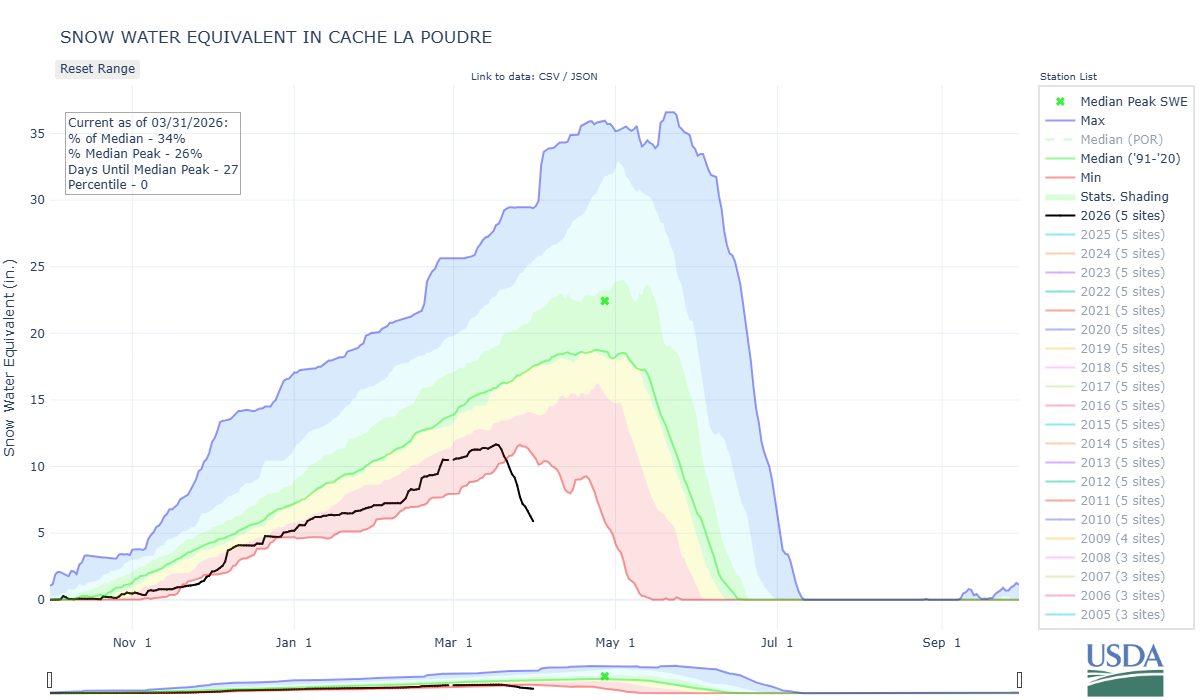
From bad to ugly! SWE in the Cache la Poudre sub-basin as of March 31, 2026.
What It Means for the Poudre
The mountain snowpack that feeds the Cache la Poudre River and its many streams and tributaries have been sitting well below average all winter. This matters because the Poudre is the circulatory system of our region, supplying drinking water to Fort Collins, Greeley and surrounding communities, sustaining approximately 185,000 acres of agriculture, and supporting the fisheries and outdoor economy that make this corner of Colorado so beloved.
When snowmelt happens fast and early, two problems compound each other: runoff moves too quickly to be absorbed by dry soils, and the water that does reach streams arrives before summer demand peaks, leaving rivers running low precisely when they are needed most. There is less total water, and it has to last longer. Fort Collins utilities draw roughly half their supply from the Poudre River directly, with the remainder coming through Horsetooth Reservoir via the Colorado-Big Thompson Project. Quota announcements for the C-BT system are expected in early April and will help determine whether formal water restrictions follow for local residents.
Droughts also severely impact stream health by reducing water levels and flow, leading to increased water temperatures, decreased oxygen levels, and higher concentrations of pollutants. These conditions can cause habitat loss, disrupt aquatic ecosystems, and can lead to fish kills, increased harmful algal blooms, and the drying up of smaller streams.
Low snowpack also dramatically increases wildfire danger by drying out the landscape weeks earlier than normal. Those of us in the Poudre Watershed know firsthand what a major fire means for water quality and supply: the 2020 Cameron Peak Fire burned deep into the river's headwaters, and its effects, like sediment, ash, and altered hydrology, continue to shape water conditions years later. State and municipal agencies are already working on fuel mitigation in the upper watershed, with a formal wildfire action plan for the Michigan Ditch corridor expected this spring. CPRW has been working to implement a 5-year, $10M dollar project in the Red Feather Lakes Area to reduce wildfire risk and protect homes from future fires.
A River That Powers an Economy

An exciting run through Pine View, a favorite class IV rapid in the Poudre Canyon (Photo credit: Rocky Mountain Adventures).
Drought is not just an environmental problem. The river is not just an ecological resource; it is an economic engine, and a dry year puts that engine under serious strain.
On the water. Commercial whitewater rafting on the Poudre generates more than $11.8 million in economic activity annually, supporting nearly 30,000 commercial user days in a normal season. But a rafting season is entirely hostage to river flows, and when flows drop below a workable threshold, outfitters cannot put boats on the water at all. Outfitters across the region are bracing for a season that starts early and ends fast, with the middle months potentially too shallow to run. When that window closes, it closes completely.
On the riverbank. Fly fishing guides face a different but equally serious challenge. Low snowpack means lower flows and, critically, warmer water temperatures by midsummer. Trout are coldwater fish with narrow thermal tolerances, and when river temperatures climb into dangerous ranges, state wildlife managers impose time-of-day fishing closures, or shut down reaches entirely, to prevent fish kills. In lean water years, those restrictions can arrive weeks earlier than normal and last much of the summer, dramatically shortening the season for guides and their clients.
On the farm. Agriculture is where the Poudre's economic stakes are highest. The river and its connected irrigation infrastructure support roughly 185,000 acres of farmland across Larimer and Weld counties, a web of crops, livestock operations, and rural livelihoods that has sustained northern Colorado communities for generations. In a low water year, farmers face hard choices: fallow fields, reduce herd sizes, or purchase expensive supplemental water on the open market. Some will not irrigate at all if their water rights are junior to senior holders who take first priority. The financial pressure cascades outward, from individual farm operations to the rural towns, equipment dealers, and processors that depend on a productive growing season. Colorado has already lost nearly a third of its irrigated acreage since the late 1990s, largely through water transfers to cities. Years like 2026 accelerate that pressure.
Taken together, these sectors represent something larger than the sum of their parts. The Poudre is estimated to generate approximately $143 million in direct and indirect economic benefits for the Fort Collins economy alone. A healthy, flowing river is not a luxury, it is the foundation on which an enormous amount of this region's economic life is built.
What CPRW Is Doing and How You Can Help
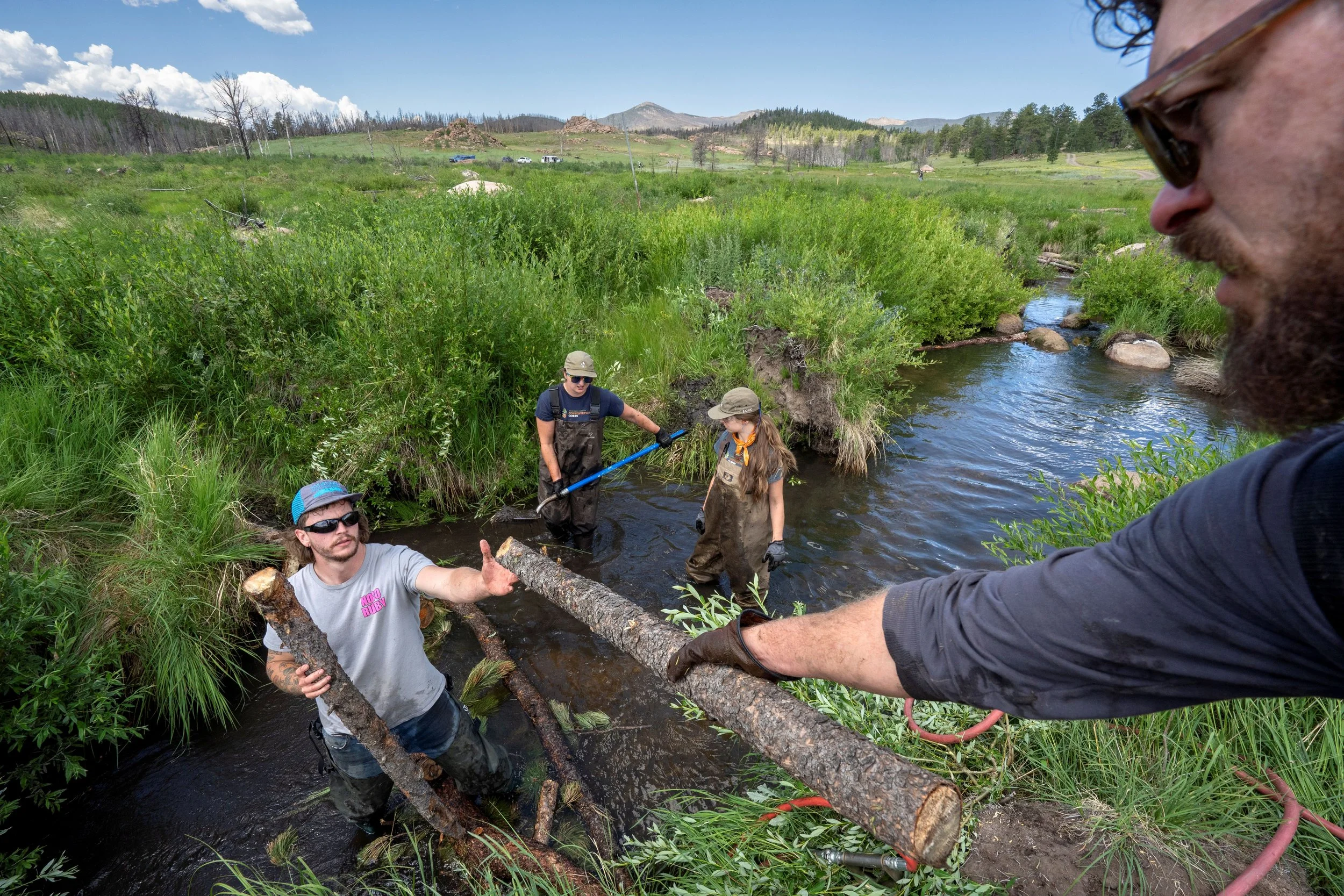
Crews build post-assisted log structures on Elkhorn Creek, a tributary of the Cache la Poudre River.
Difficult years like this one clarify why long-term watershed stewardship is so essential. A watershed in good ecological health, with restored riparian corridors, reduced wildfire fuel loads, and functioning natural systems, handles stress better than one that is degraded. Every restoration effort we complete, every monitoring site we maintain, every acre of forest we help protect from catastrophic fire is an investment in the Poudre's resilience when conditions are hardest.
In 2026, CPRW is moving forward on several fronts (read this blog for all our 2026 plans): finalizing our Upper Poudre Wildfire Ready Action Plan, continuing water quality monitoring at more than 20 sites through our Community Science program, and completing our Watershed in Focus report, a comprehensive, data-driven assessment of river health across the entire watershed. These efforts build the knowledge and partnerships that will carry us through this dry year and position the Poudre for recovery. In addition, we will complete 4 additional stream restoration projects as well as adaptative management on already completed projects using low-tech, process-based restoration to restore degraded or damaged riverscape ecosystems, helping to improve water retention, soil formation, and carbon sequestration.
There are also immediate ways to help. Conserving water at home this spring and summer matters—prioritize established trees over lawn turf, and hold off on irrigation as long as conditions allow. Attend one of CPRW’s many volunteer days or community events throughout the year. And if you are able, consider supporting CPRW's restoration work, because a healthier watershed today is a more resilient one when the next drought hits.
The Poudre has endured a lot. Fires. Floods. Diversions. Droughts. It is still here because generations of people chose to care for it. This spring, with the snowpack gone early and a long dry summer ahead, it needs that continued commitment from all of us.