From Emergency Response to Long-Term Resilience: Managing Watersheds That Are Ready for Fire
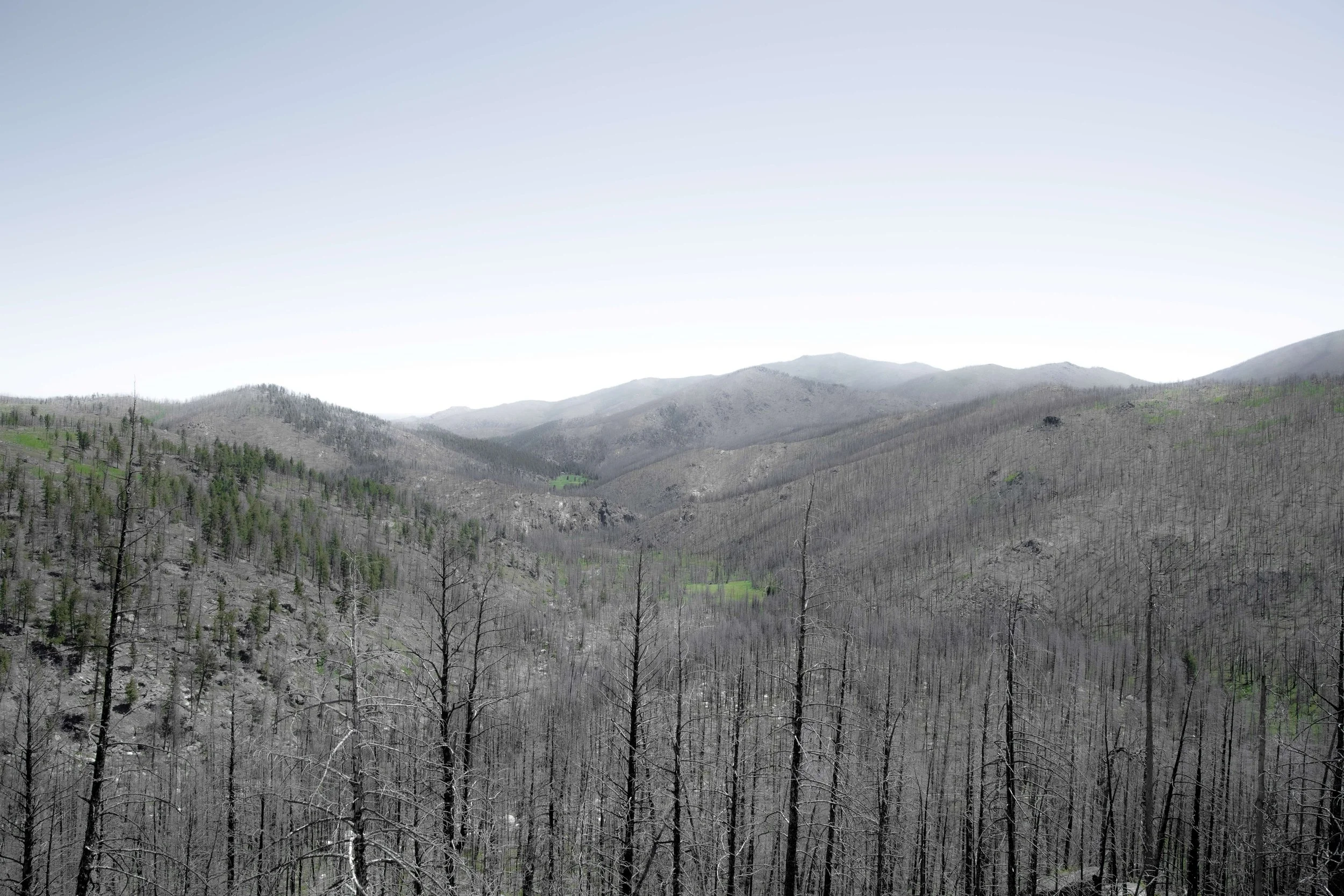
The Cache la Poudre River Watershed is a landscape shaped by fire. Photo credit: Cory Dick
Let's all take a moment to sit with the fact that it has been more than 2,000 days since the Cameron Peak Fire (CPF) was declared contained. In the roughly five and a half years since the Front Range collectively exhaled a sigh of relief, CPRW and our partners have been hard at work making the most of the critical window of time when the threats of disastrous flooding, debris flows, and water quality impacts following a large-scale wildfire are at their highest.
And we have achieved a lot in that time. CPRW and our partners have completed 17 stream restoration projects, covering approximately 11 miles of stream and 61 acres of habitat restored, with more than 700 structures installed, all designed to create naturally resilient systems that capture sediment and excess nutrients from the burn area and act as a speed bump against the higher flows that follow severe wildfires. In addition to this work we have planted more than 43,000 trees in high severity burn areas. We have partnered with researchers at Colorado State University, CU Boulder, Grand Mesa University, Colorado Forest Restoration Institute, Riverscape Science & Stewardship, and the Rocky Mountain Research Station to study the impacts of our work. This extensive research and monitoring focuses on how our stream and wetland restoration efforts, particularly low-tech process-based restoration (LTPBR), affect hydrology, ecology, water quality, and wildlife, often in the context of post-wildfire recovery in Colorado. Topics of research include:
Sediment & Hydrology
Sediment and nutrient buildup in channels and floodplains (Pawlowski)
Post-fire impacts on sediment accumulation and groundwater storage (Jones)
Floodplain storage and flow path effects on flood attenuation (Christensen)
Biogeochemistry & Water Quality
Restored wetlands acting as carbon/nitrogen sinks after wildfire (Fegel)
Vegetation & Ecology
Vegetation and floodplain changes 1–5 years after restoration (Atkinson)
Wet meadow restoration for wildfire resilience (Rhea)
Microbiology
How stream corridor microbiomes shift after Low-Tech Process-Based Restoration (LTPBR) (James)
River & Stream Dynamics
Hydrologic, geomorphic, and ecologic evolution of restored river sites (Scott)
Water dynamics in beaver-restored stream corridors (Sholtes)
Wildlife
Brook trout movement patterns around LTPBR structures (Knutson)
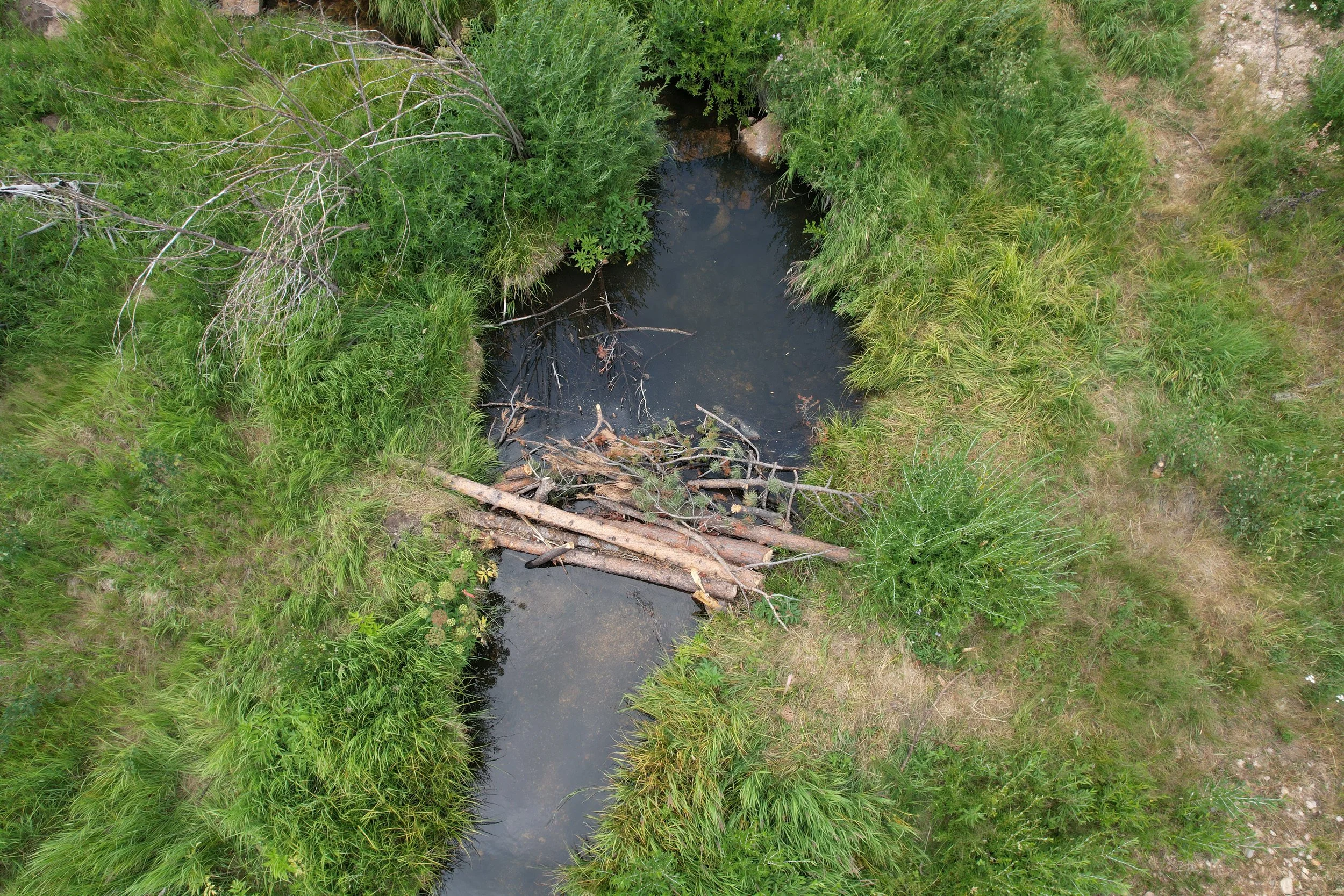
A beaver dam analog (BDA) installed on Elkhorn Creek in the Cameron Peak burn area.
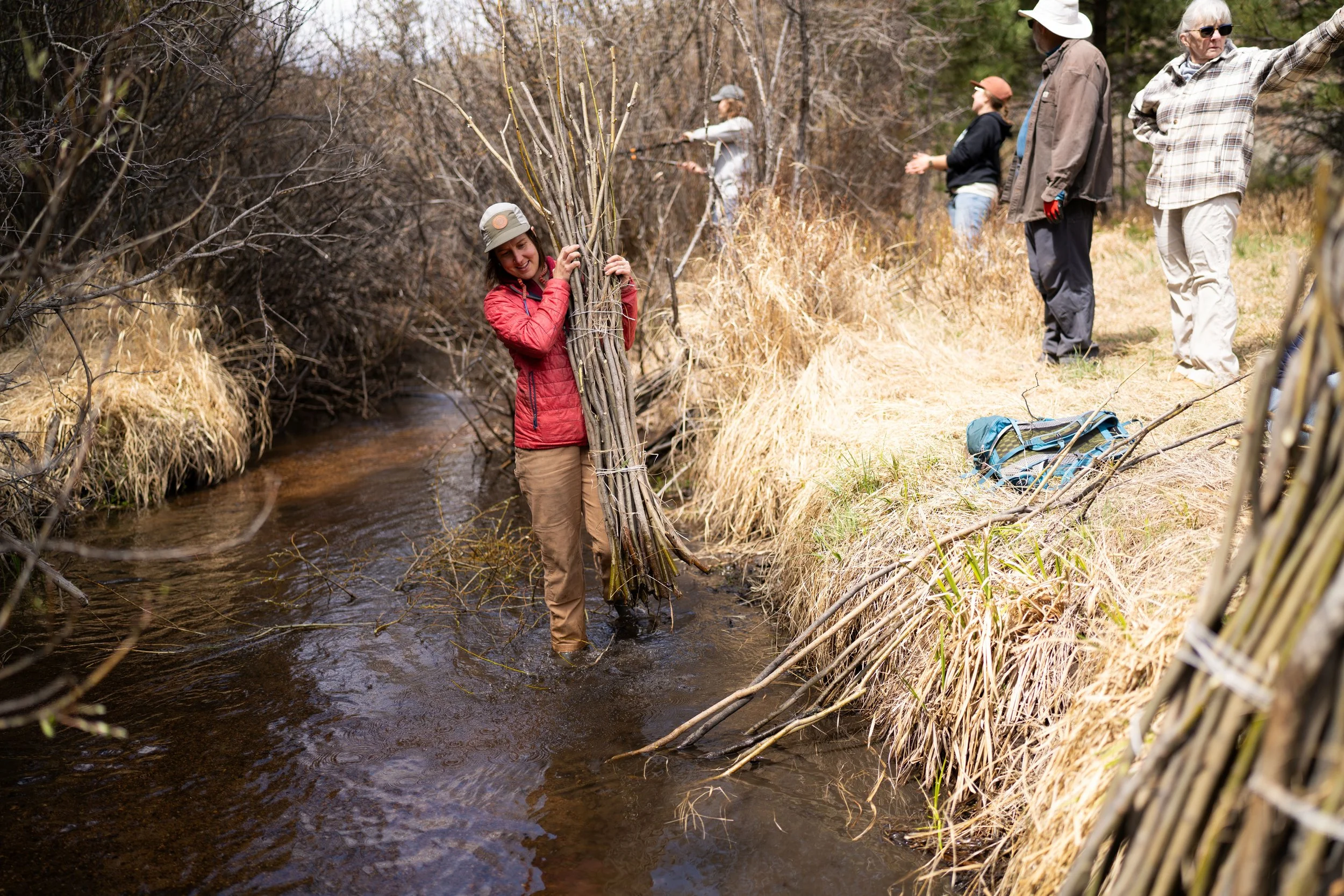
Taryn Contento, CPRW’s Post-Fire & Rivers Project Manager, collects willow for riparian planting at our stream restoration projects.
But the work to restore a landscape impacted by a 208,000-acre fire is far from done. Research on the High Park Fire tells us that nitrogen and phosphorus remain elevated for decades after a fire goes out. Walking the Cameron Peak Fire footprint today, you can still find areas where vegetation hasn't returned and where there is no revegetation, the changes to hydrology continue to affect how our streams and rivers function. At the same time, we see the landscape changing for the better, and research confirms we are moving farther from the immediate threats of flooding and debris flows.
Our watershed is now at a different point along the fire regime, and that shift is changing how we think about our work. We have expanded our goals beyond responding to wildfire and have started designing projects that will help us receive the next wildfire because fire is not bad. Fire is a natural part of our landscape, and if we can prepare in advance, we can support the kind of beneficial fire that makes our watershed healthier and more resilient. With that perspective guiding us, we are looking forward to projects that keep post-fire restoration in mind while directly incorporating additional goals like fish habitat improvement, riparian vegetation expansion and wildfire resilience.
We are pairing stream restoration with wildfire mitigation, using materials from forest thinning and defensible space treatments to supply biomass to our wood-starved streams. Stream restoration and wildfire mitigation don't have to be separate efforts. By integrating watershed restoration into our wildfire management work, we can re-wet degraded stream corridors, meadows, and valley floors. This isn't just good for nature, it's a fire management strategy. When water tables rise and wetland vegetation returns, those areas become "wet fuel breaks" that wildfires struggle to cross. Also, this doesn't always require massive infrastructure. Some of the most effective techniques are surprisingly low-tech, such as beaver mimicry structures, log jams, and riparian plantings.
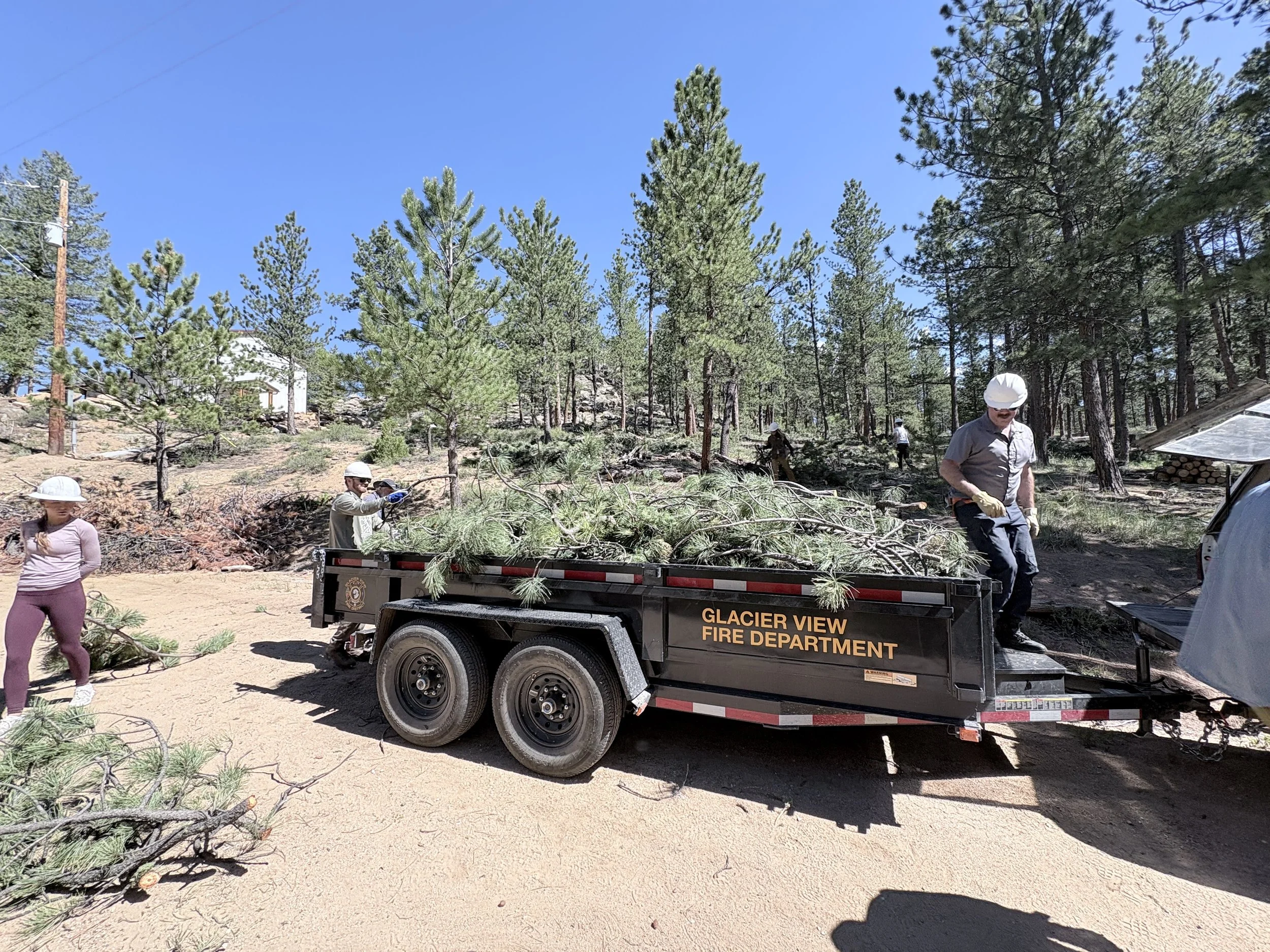
Volunteers from Tellus work to collect slash from a private property in Glacier View within the Red Feather Lakes Area Wildfire Defense Project area. The slash was used in a nearby restoration project on Elkhorn Creek.
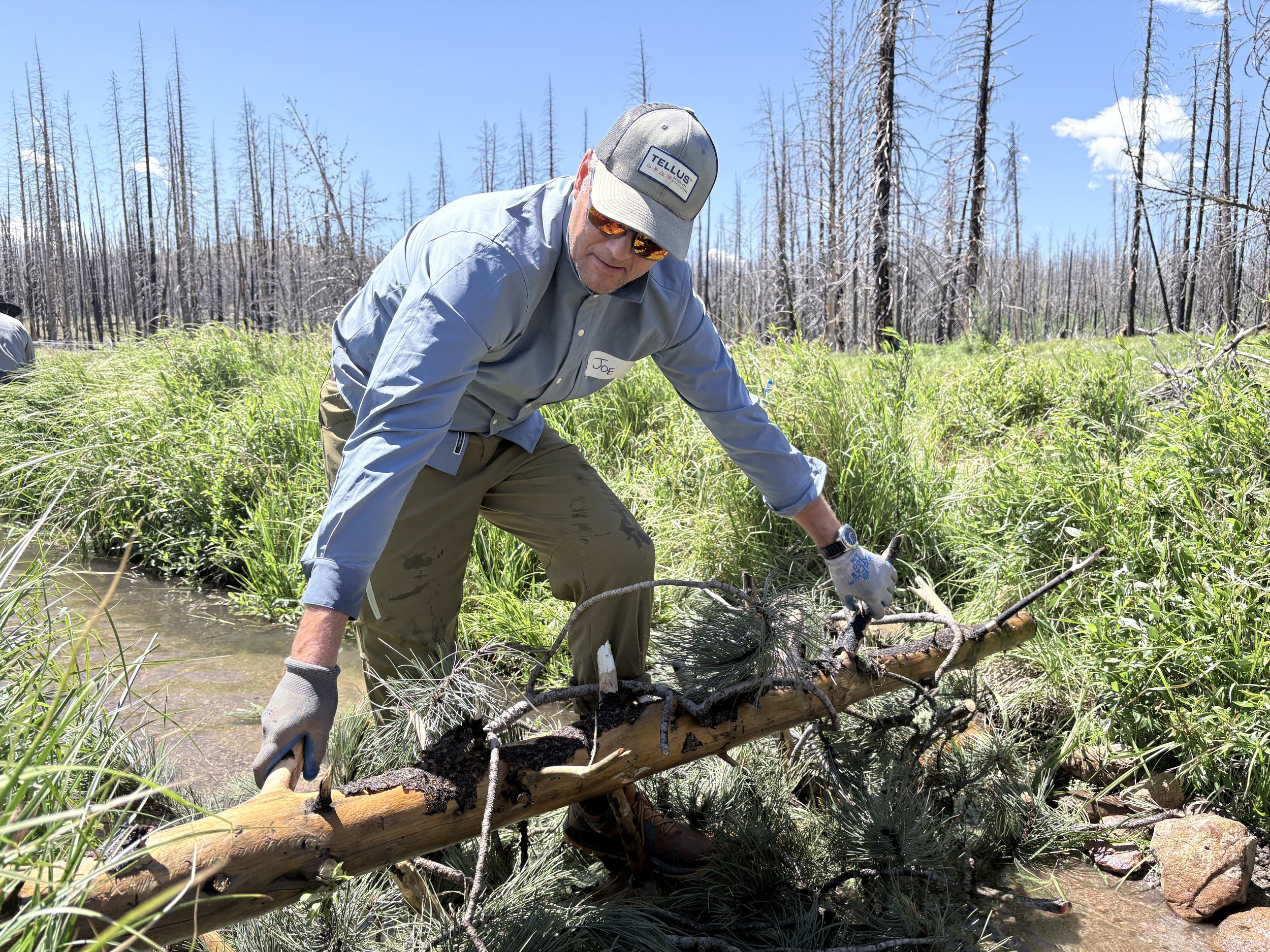
Joe Basta, owner of Tellus Outdoor, builds a beaver dam analog (BDA) using materials collected from a wildfire mitigation project in Glacier View the day before.
In 2026, we have the following stream restoration projects planned. Take some time to explore each of the projects:
Upper Elkhorn Creek - Adaptive Management (completed June 27-28)
South Fork of the Poudre - Adaptive Management (in progress)
Elkhorn Creek at Dall - Post-Fire Stream Restoration (in progress)
Elkhorn Creek at the Scout Ranch - Stream Restoration (August 2026)
Laramie River Channel Resiliency Project - Post-Fire Stream Restoration (July-August 2026)
Sheep Creek at Zimmerman - Post-Fire Stream Restoration (Sept-Oct 2026)
Interested in exploring this work on the ground? SAVE THE DATE for August 15 when we will tour Elkhorn Creek at the Scout Ranch with our partners at the Larimer Conservation District. Stay tuned for details!
We are grateful to be supported in this work by our federal, state, and municipal partners, and we are energized by what comes next. The goal isn't to live in a "post-fire" or "pre-fire" landscape, it's to embrace where we actually are: a continuum, an inter-fire landscape.
Questions? Email Taryn Contento, Post Fire & Rivers Project Manager, at taryn@poudrewatershed.org